You can still be getting your period and wondering what is happening to your body. Chinese Medicine calls the transition to menopause a Second Spring and offers a different way to understand and support it.
By Gudrun Snyder, DAc, LAc, Dipl.Ac. (NCCAOM), Founder of Moon Rabbit Acupuncture

You can still be getting your period and be in perimenopause.
If no one ever told you that, you are certainly not alone.
Perimenopause is the transition leading up to menopause, and it can begin years before your final period. Early on, you may still bleed every month. There is no announcement that says, this is what is happening to your body now.
Instead, you stop sleeping the way you used to. Your periods change. You feel hotter, more anxious, or more irritable. Your skin seems different. Your weight shifts. Sex feels different. Your brain gets foggy, and you walk into a room with no idea why you are there.
And you start wondering: What is happening to me?
September is Perimenopause Awareness Month, which gives us a reason to say this out loud. But awareness cannot stop at a list of symptoms. Women need a way to make sense of the transition and something useful to do next.
Someday, my daughter may be that woman. I do not want her to discover perimenopause because she Googled, "Why don't I feel like myself anymore?" at two in the morning. I want her to know the language, the options, and the questions to ask before she feels blindsided.
"It's normal" should not end the conversation
Women looking for answers are often told try birth control, consider hormone therapy, exercise more, or don’t worry because it is normal.
These are not inherently bad answers. Menopausal hormone therapy is an evidence-based option for many women, and nonhormonal treatments are also available. Movement matters. But any option offered without listening, explanation, or follow-up can feel like dismissal.
"It's normal" should never be the end of a conversation about a woman's health.
Normal does not mean imaginary. It does not mean insignificant. And it certainly does not mean you should quietly endure symptoms that are disrupting your sleep, work, relationships, comfort, or sense of self.
My menopause did not come gradually
I entered this chapter quickly - like jumping off a cliff. I had breast cancer for the first time at 31. After a mastectomy, I began taking tamoxifen, which blocks estrogen's effects in breast tissue and can bring hot flashes and other menopause-like symptoms into a woman's life much earlier than expected.
At 40, I had a hysterectomy. At 41, my cancer returned. I went through chemotherapy and later had an oophorectomy, the removal of my ovaries. That is when menopause officially arrived.

Afterward, I went to see my OB/GYN. She told me I did not need to see her anymore. Why? I asked. Because I no longer had a uterus or ovaries.
I said okay. I walked out. And somewhere between her office and the elevator, I thought: But I still have a vagina. Does my vagina not matter anymore?
It is funny when I tell the story now, until it is not. The history of women's health is full of symptoms being psychologized or explained away. Even the word hysteria traces back to the Greek word for uterus. We have better medicine now, but dismissal has not disappeared.
I did not ask more questions that day. I did not insist on a better answer. This letter is partly for my daughter because I hope she never simply walks away.
Chinese Medicine gave me a different map
I was fortunate in one important way: Chinese Medicine, including acupuncture, herbal medicine, food therapy, and movement, had been part of my life throughout all of this. It gave me both care and a different story about what was happening.
In contemporary Chinese Medicine, the transition toward menopause is often described as a Second Spring. Rather than reducing midlife to decline, this lens treats it as a new season, one in which the body has different requirements and deserves more intentional care.
Biomedical medicine explains perimenopause through changing ovarian function and fluctuating hormones. Chinese Medicine uses a different map: Jing, Yin, Blood, Qi, and Shen. These frameworks are not interchangeable, and they do not need to compete. One helps identify medical risks and evidence-based treatment options; the other can help us see patterns across the whole person and build daily practices around them.
At the center of Chinese Medicine's understanding of aging is Jing, often translated as Essence. I describe it to patients as the body's deepest reserve. Some is inherited; some is influenced by how we nourish ourselves, rest, recover, and live.
The Huangdi Neijing, a foundational Chinese medical text, describes women's physiology in seven-year cycles, with a significant transition around the seventh cycle, traditionally age 49. That age is not a stopwatch. Every woman's timing is different. The value of the image is that change is expected - and worthy of preparation.
As Kidney Jing and Kidney Yin become less abundant in this traditional framework, a woman may experience more heat and dryness, changes in sleep, skin, hair, and vaginal tissue, or a sense that her reserves are not what they once were. The response is not simply to fight the symptom on the surface. It is to tend the root.
The Liver offers another useful lens. In Chinese Medicine, it is responsible for the smooth movement of Qi and Blood. When that movement becomes constrained, the pattern may include irritability, tension, bloating, changing cycles, digestive sluggishness, or disrupted sleep. Shen refers to the spirit or mind, reminding us that emotional steadiness and sleep belong in the health conversation too.
Chinese Medicine does not ask us to pretend the body is not changing. It asks us to change how we care for it.
Five things I wish every woman would start in perimenopause
Track the pattern, not just your period
For six to eight weeks, note your cycle dates and flow along with sleep, hot flashes or night sweats, mood, headaches, brain fog, vaginal or urinary changes, and anything new in your medications or routine. A pattern is far more useful to you and your clinician than trying to remember a bad month in a ten-minute appointment.
Do not assume every new symptom is perimenopause. New, unusually heavy, or otherwise concerning bleeding deserves medical evaluation. You also do not need to wait until you have gone 12 months without a period to ask for help.
Move Qi every day, and protect your strength
From a Chinese Medicine perspective, movement keeps Liver Qi from becoming constrained. Walk, practice yoga or Pilates, try qigong or tai qi, dance, or do the form of movement you will actually repeat. Include strength work because muscle and bone matter enormously in midlife. Movement is care, not punishment for a changing body.
Nourish instead of restricting
You do not need a menopause cleanse. Build meals around enough protein, fiber-rich plants, nourishing fats, and foods that genuinely sustain you. Fermented foods such as miso, kimchi, yogurt, or kefir can be useful additions if they agree with your digestion.
Chinese dietary therapy often turns to foods traditionally associated with nourishing Kidney Yin and Jing: black sesame, black beans, black rice, walnuts, eggs including the yolk, fatty fish, sea vegetables, goji berries, and jujube dates. These foods are not cures. The point is to replace the language of deprivation with the practice of nourishment.
Learn three acupressure points
Use comfortable, steady pressure for about 30 to 60 seconds while breathing slowly. Acupressure is a supportive ritual, not a substitute for diagnosis or treatment.
HT 7 - Shenmen, or Spirit Gate: At the wrist crease on the little-finger side. Traditionally used to calm Shen (your mind and spirit) and support rest when the mind feels busy or unsettled.
SP 6 - Sanyinjiao, or Three Yin Intersection: About four finger-widths above the inner ankle, just behind the shinbone. A classic point in Chinese gynecologic care. If you are pregnant, ask a qualified practitioner before using this point.
Auricular Shenmen: In the triangular fossa of the ear. This is one of my favorite ear-seeding points and an easy place to bring a small moment of acupressure into the day.

Facial gua sha can be another three-minute ritual. Apply facial oil, use light pressure, and sweep slowly upward and outward. I do not think of it as a facelift in a stone. I think of it as a way to encourage circulation, temporarily ease puffiness, and touch your face with attention rather than criticism.
Get individualized care before you are desperate
Sleep disruption, hot flashes, mood changes, and vaginal or urinary symptoms are health issues, not character flaws. Vaginal dryness, irritation, pain with sex, and urinary changes may be part of genitourinary syndrome of menopause, and they deserve specific care. Ask about your full range of options, including hormone and nonhormone treatments, and make decisions with a clinician who understands your history. If you have had hormone-sensitive cancer, include your oncology team.
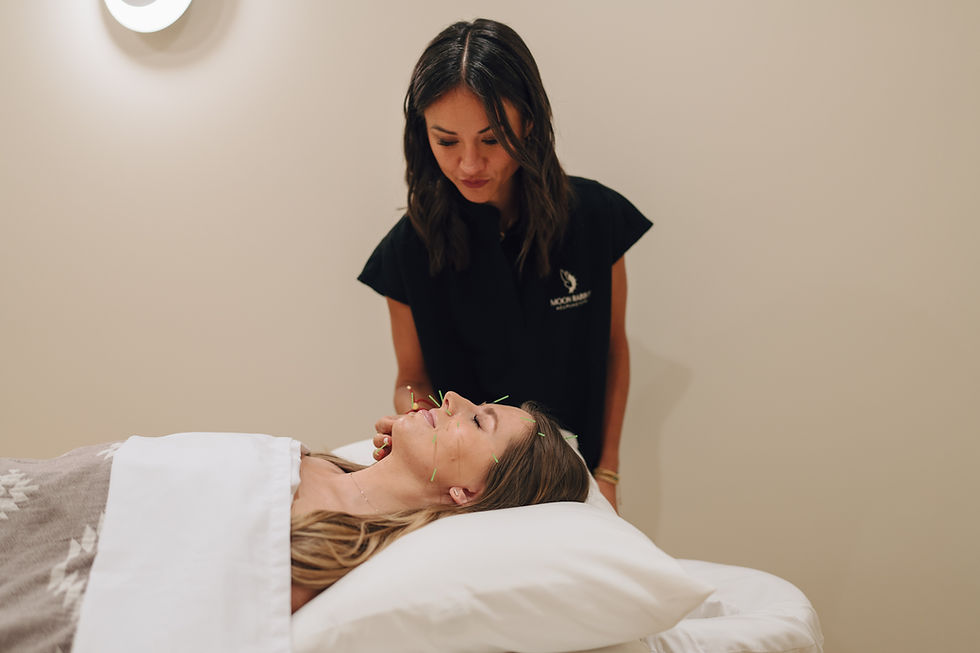
Acupuncture may help some women with vasomotor symptoms and quality of life, although research findings are not uniform and it should not replace medical evaluation. Herbal medicine is even more individual. Two women can walk into my clinic with the same complaint - hot flashes - and receive different formulas because the pattern beneath the symptom is different.
One herb that illustrates this specificity is schisandra, called Wu Wei Zi, or Five-Flavor Seed. It is valued in Chinese herbalism because it contains all five traditional flavors and is used within formulas for particular patterns. That does not make it universally appropriate. Herbs and supplements can interact with medications and cancer treatment, so this is not the place to self-prescribe.
For a simpler ritual, a caffeine-free tea can create a welcome pause. Moon Rabbit's Women's Blend combines rooibos, rose hips, nettle, and plum. I think of it as a nourishing ritual, not as hormone therapy or a treatment. If you are pregnant, breastfeeding, taking medication, undergoing cancer treatment, or have a history of hormone-sensitive cancer, review herbs and supplements with your healthcare team first.
What I want my daughter to know
If you are in perimenopause now, you do not need to wait until menopause to start paying attention. This is the time to learn your body again. Notice what has changed. Ask questions. Find practitioners who listen. Use the tools available to you - Western medicine and Eastern medicine alike - and begin building the care that can carry you into your Second Spring feeling informed rather than blindsided.
Your body is not failing. It is shifting. Its requirements have changed. This is not about reversing time. It is about flourishing within the transition to your Second Spring.
My grandmother's name was Chuan, which means river or stream in Chinese. I love the idea that what we learn can flow forward from one generation of women to the next.
So I write this for my daughter, and for every woman who will eventually enter her own Second Spring. I hope you know more than I did. I hope you ask questions, advocate for yourself, and expect to be heard. I hope you never accept "it's normal" as the end of the conversation when you know something in your body has changed.
Use the tools available to you. Take what works from Eastern medicine and Western medicine. Move your body. Nourish it. Rest. Stay curious. Keep looking for the people who help you feel like yourself.
Most of all, I hope you understand that this chapter is not about becoming less.
There is still so much life ahead of you.
May what we have learned flow forward, and may you enter your Second Spring with more knowledge, more confidence, and more possibility than the women who came before you.
Sources and further reading
The Menopause Society. "Perimenopause." Overview of bleeding changes, vasomotor symptoms, brain fog, genitourinary symptoms, and treatment considerations.
National Cancer Institute. "Hot Flashes and Night Sweats (PDQ): Patient Version." Treatment-related menopause, hot flashes in cancer survivors, and cautions concerning herbs and supplements.
National Center for Complementary and Integrative Health. "Acupuncture, as Practiced in Clinical Settings, May Significantly Improve Menopause-related Symptoms." Summary of the Acupuncture in Menopause pragmatic randomized trial and its limitations.
Traditional source: Huangdi Neijing, Suwen, Chapter 1, on women's seven-year physiological cycles.
Recommended reading: The New Menopause by Mary Claire Haver, MD.
This article is for educational purposes only and is not medical advice. Consult a physician or another qualified healthcare professional about individual symptoms and before beginning herbs, supplements, or a new treatment regimen.


.webp)