Moonlight, a Goddess, a Rabbit & Mooncakes

Every autumn, on the fifteenth day of the eighth month of the lunar calendar, families across China, throughout Asia and in communities around the world gather beneath one of the brightest full moons of the year. This year, that night falls on Friday, September 25, 2026.
This is the Mid-Autumn Festival, also known as the Moon Festival: a celebration of family, harvest, abundance and reunion. It's filled with some of our favorite things: gathering around a table, spending time outside, sharing food, looking up at the moon and telling stories passed down from one generation to the next.
At Moon Rabbit, it's an especially meaningful celebration. Woven into those stories are Chang'e, Hou Yi and the Jade Rabbit, the characters whose legends eventually gave us our name.
But before we get to the Rabbit, we have to start with the moon.
Why the Moon Matters
The Mid-Autumn Festival falls when the moon is traditionally believed to be at its fullest and brightest.
In Chinese culture, the full moon has long represented wholeness and reunion. Its round shape is a symbol of completeness: families coming together, loved ones returning home, relationships made whole. There is something beautiful in the idea that even when we can't be together, we can still look up and see the same moon.
For generations, families have marked the festival by eating together, lighting lanterns, making offerings, sharing mooncakes and admiring the moon. And like many ancient traditions, it is rooted in myth.
One of the most beloved begins with an archer named Hou Yi.
Hou Yi and the Ten Suns
Long ago, according to legend, ten suns appeared in the sky at once. Their combined heat scorched the earth. Crops withered, rivers dried up and people could no longer survive beneath the blaze.
Hou Yi, a legendary archer, raised his bow and shot nine of the suns from the sky, leaving just one to warm the earth.
For this extraordinary act, the Queen Mother of the West rewarded him with an elixir of immortality. But immortality posed a problem. Hou Yi was deeply in love with his wife, Chang'e, and did not want to live forever without her. So instead of drinking the elixir, he brought it home.
While Hou Yi was away, one of his own apprentices tried to steal it. Chang'e was home alone, and rather than let the elixir fall into his hands, she drank it herself. She began to rise into the sky, higher and higher, until she reached the moon. There, she became immortal.
When Hou Yi returned and learned what had happened, he was devastated. He went outside and looked up. The moon that night was especially bright, and according to legend, he could see Chang'e within it.
Hou Yi missed her dearly. So each year, beneath the brightest moon, he set out her favorite foods: fruit, sweets and cakes. Word spread, and soon others began leaving offerings beneath the moon too. Over time, the tradition became woven into the Mid-Autumn Festival itself.
To this day, Chang'e remains the figure most closely associated with the holiday. But she is not alone on the moon. There is also a rabbit.
Look Closely at the Moon
Study the shadows and markings on a full moon and you may see the shape of a rabbit. People have seen it for centuries. In Chinese mythology, it became Yùtù (玉兔), the Jade Rabbit, often shown beside Chang'e, pounding herbs with a mortar and pestle to prepare the elixir of immortality.
For those of us who practice Chinese Medicine, it's a particularly lovely image: a celestial rabbit on the moon, forever working with medicine.
So how did the Rabbit become Chang'e's companion?
How the Jade Rabbit Reached the Moon
In one folktale, which traveled to China with Buddhism, the Jade Emperor, ruler of heaven, came down to earth disguised as a poor, hungry old man. He wandered into the countryside and asked the animals for food, and they went searching.
The monkey gathered fruit. The fox caught a fish. The chicken laid an egg. But the Rabbit searched everywhere and found nothing to offer.
Heartbroken that it had nothing to give, the Rabbit made an extraordinary choice: it built a fire and offered itself as food. Before the Rabbit could be harmed, the old man revealed himself as the Jade Emperor. Moved by its compassion and selflessness, he saved the Rabbit, granted it immortality and brought it to live on the moon, where it became the Jade Rabbit.
Over time, the stories of Chang'e and the Jade Rabbit intertwined. Today the two are imagined together in the Moon Palace, the Rabbit endlessly at its mortar and pestle, preparing the elixir of immortality.
The Mooncakes
Perhaps the most delicious part of the Mid-Autumn Festival is the mooncake: a round pastry traditionally filled with lotus seed paste, red bean, nuts or salted egg yolk. Today you'll find endless regional and modern versions, from snow-skin mooncakes to fillings like matcha, custard and even ice cream.

Their round shape echoes the full moon and symbolizes togetherness and reunion. Families often cut a single mooncake into pieces so everyone at the table shares from the same one.
Mooncakes have centuries of history and many origin stories. But every year, when we set out mooncakes at Moon Rabbit, we think of Hou Yi leaving cakes beneath the moon for his beloved: food as a way of remembering someone far away, and of gathering beneath the same moon.
Autumn, Through the Lens of Chinese Medicine
In Chinese Medicine, autumn belongs to the Metal element and the Lungs. It's a season of harvest and of letting go, a time to slow down, turn inward and protect ourselves from the dryness that arrives as the weather cools.
The Lungs are also associated with grief. So autumn can be a tender season, when we feel the absence of the people we've lost more deeply. The Mid-Autumn Festival holds both: gratitude for what we've gathered, and a quiet moment to honor who is no longer at the table.
Why the Mid-Autumn Festival Is So Special to Us
Mid-Autumn is one of our favorite festivals at Moon Rabbit. The holiday isn't about acupuncture or Chinese Medicine, but so much of what surrounds it reflects what we believe. It's about connection. It's about the rhythms of nature. It's about gathering with the people you love.
And at the center of its mythology sits a little rabbit, working away with its mortar and pestle, preparing medicine beneath the moon. We couldn't love that more.
This Mid-Autumn Festival
Take a few minutes to go outside. Look up. Really look at the moon. Maybe you'll see Chang'e. Maybe you'll see the outline of a rabbit.
Share a mooncake with someone you love. Gather around a table. Call someone who feels far away.
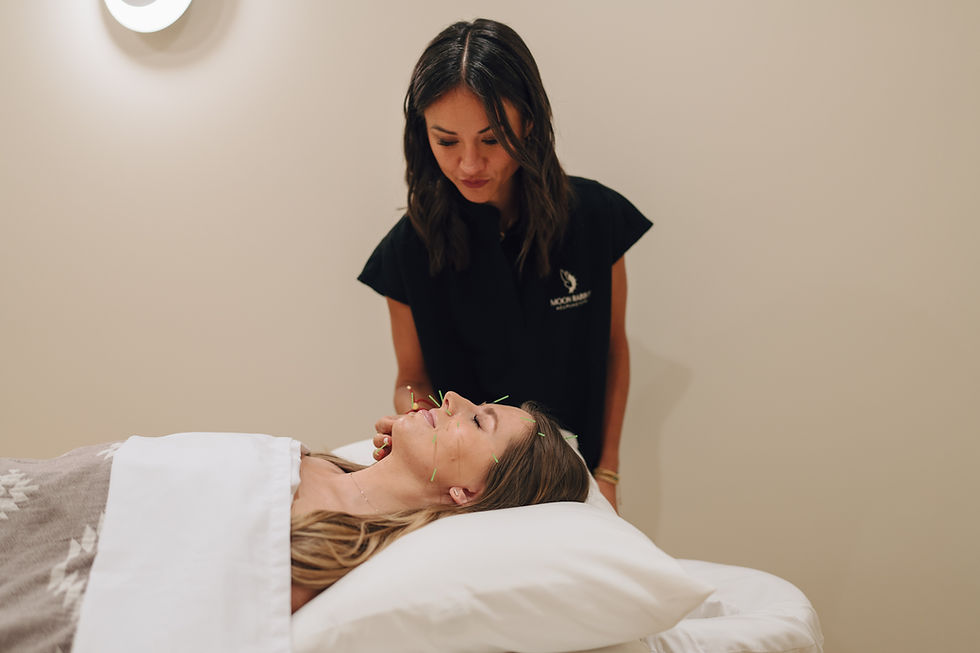
And come see us. From Wednesday through Sunday September 27, every guest who books a treatment or makes a purchase at our West Loop or Lincoln Park locations will receive a mooncake to take home, while supplies last.
Behind all the mythology and tradition is something simple: the people we love matter. Being together matters. And sometimes looking up at the same moon is enough to remind us.


.webp)